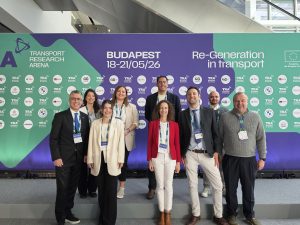
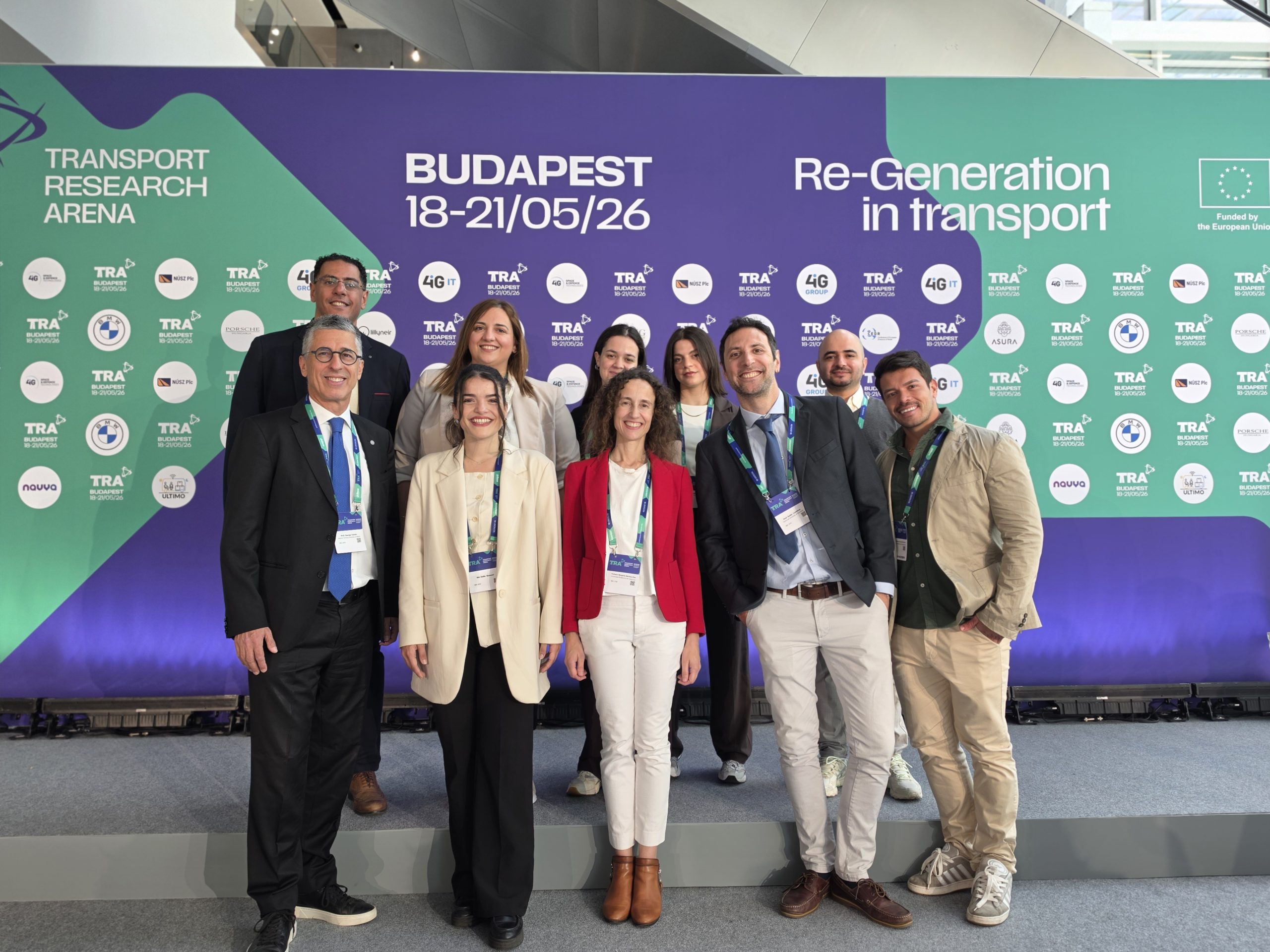
Held in Budapest from 18 to 21 May, the Transport Research Arena (TRA) 2026 served as a key meeting point for Europe’s transport research and innovation community. Co-organised by the European Commission, the event discussed the future of transport under the theme “ReGeneration in transport”.
CulturalRoad contributed to the programme with three papers, exploring how automated mobility can be deployed in ways that are equitable for all users. The project was also represented at the ERTICO stand, offering attendees a chance to find out more about CulturalRoad’s approach and methodology.
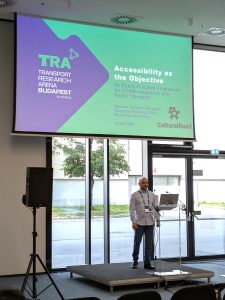
Peyman Hashemi Baragoori (Universitat Politècnica de Catalunya) presented the paper “Accessibility as the Objective: An Equity-Focused Framework for CCAM Integration in Public Transport Networks“, co-authored with Margarita Martínez-Díaz and Mohamed Abouelela, during Technical session 5. This study presents a proactive, location-based optimisation framework designed to integrate CCAM shuttles (CS) as first-mile and/or last-mile feeders into existing public transport systems, specifically targeting equitable access to essential destinations. It first identifies those areas in which low accessibility by public transport is coupled with sociodemographic characteristics indicative of (mobility) vulnerability, such as low income or education levels, or low rates of car ownership, among others. The novel KPI Accessibility Gain Ratio (AGR) is introduced with the objective of maximising reachable essential opportunities (such as healthcare and education) while minimising total generalised travel costs (incorporating travel time, transfers, and fares, but also value of time). The application of the framework to the city of Barcelona demonstrates that there is no one-size-fits-all solution; the success of CCAM shuttle integration was showed highly dependent on the chosen fare structure. For example, under distance-based pricing schemes, slower automated CCAM shuttles successfully outperformed manual-driven, quicker shuttles, because their lower perceived value of time offset their lower operating speeds. The paper concludes that strategically planned CCAM integration can significantly boost equitable mobility, provided that public planners carefully design and test fare schemes to match local geographic patterns and demands.
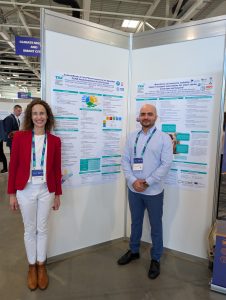
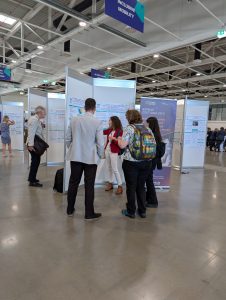
“CulturalRoad: A Five-Pillar Framework for Equitable CCAM Implementation Across Europe“, written by Paraskevi Koliou, Margarita Martínez-Díaz, Guido Cantelmo, Mohamed Abouelela, Sarah Stelter, Ramandeep Singh, George Yannis, and Arantxa Carolina De La Hoz Morris, was presented by Margarita Martínez Díaz (UPC) during a poster session. The paper addresses the critical need to ensure that the deployment of CCAM systems is socially equitable and context-sensitive across diverse cultural and geographical regions. In fact, it summarises the quantitative methodology proposed by CulturalRoad with this goal: the Five-Pointed Star Rating System. This is a novel evaluation framework organised around five core pillars: i) Inclusivity, which includes accessibility, affordability and other aspects such as physical or digital accessibility, ii) Network Optimisation, which accounts for the combination of scheduled-based and frequency-based transport solutions, iii) Safety, both for CCAM users and other actors, iv) Acceptance, which includes considerations about the Value of Time, among others, and v) the role of Psychological Factors such as personality attributes of affinity for technology. The methodological framework is reflected in various KPIs that, once estimated, will make it possible to assess the degree of equity in any design or implementation, as well as to compare different CCAM solutions across different geographical and cultural context. Ultimately, the framework underscores that ensuring equitable deployment requires moving beyond traditional operations-related metrics to actively address underlying psychological barriers, user trust, and cultural attitudes.
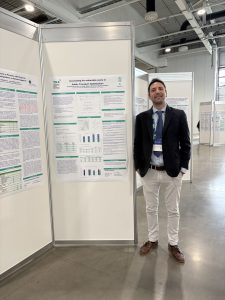
“Accounting for Vulnerable Users in Public Transport Optimisation“, by Arantxa De La Hoz, Yu Jiang, Jesper Bláfoss Ingvardson and Guido Cantelmo, was presented during a poster session by Guido Cantelmo (Technical University of Denmark). The paper presents an integrated optimisation framework for public transport networks that explicitly accounts for user heterogeneity and mobility-related vulnerabilities. While most existing public transport optimisation approaches treat schedule-based and frequency-based services separately and assume homogeneous demand, this work incorporates the travel Preferences of People with Mobility Disabilities (PwMD), who are often more sensitive to transfers and accessibility constraints. The proposed model jointly optimises service frequencies and timetables while considering both passenger costs and operational costs, realistic capacity constraints, and route choice behaviour through a Multinomial Logit formulation. A case study based on the Copenhagen metropolitan area demonstrates that including vulnerable users in the optimisation process does not significantly increase system costs or reduce efficiency. The results show that operational performance remains comparable to traditional homogeneous-demand scenarios, while producing more equitable solutions. Overall, the framework highlights the importance of integrating equity considerations into transport planning and provides a practical tool for designing more equitable public transport systems.
Participation in TRA 2026 reinforced CulturalRoad’s connections with the broader CCAM research and policy community and provided a valuable opportunity to exchange with researchers, industry representatives, and policymakers on the challenges and opportunities shaping automated mobility deployment across Europe.