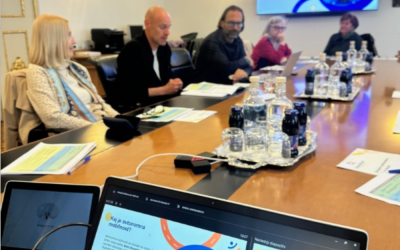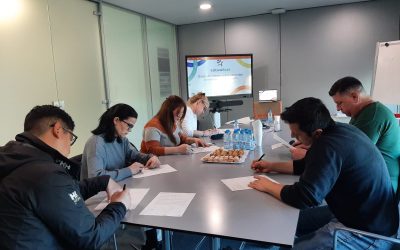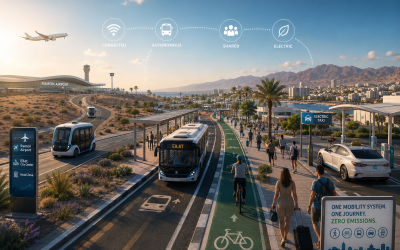

As part of CulturalRoad’s two-step co-creation framework across all five demonstration regions, our partners INIT and Karlsruhe Institute of Technology (KIT) hosted an online stakeholder workshop for the Karlsruhe demonstration site. The goal was to collect practical insights on how automated mobility services can be inclusive, fair and accepted in everyday use.
The session was moderated by Andrea Demetrio (INIT) and Veronika Stein (KIT). Participants were invited to contribute perspectives through discussion and short written notes to different capture viewpoints on equitable future mobility. Additionally, Maximilian Schrapel (KIT) gave a first introduction into the digital twin developed for the Karlsruhe use case.
Who took part
The workshop brought together five key actors from real-world deployment. These included experts working on standardisation and passenger information, public transport operators with experience from automated shuttle services, researchers working on automated driving and safety validation. Two main questions arose from the discussion: What makes CCAM services hard to introduce in day-to-day operations, and where they can bring real benefits, for which groups, and in which local contexts.
Key workshop insights
Acceptance is also an internal topic: Many discussions about automated mobility focus on public acceptance. Stakeholders remarked that acceptance inside operating organisations is equally important. Roles, responsibilities and job-related concerns can strongly influence whether a service runs smoothly. In everyday operation, staff often remain the first contact for passengers, for example when a disruption happens or help is needed. This human role must be considered in service design.
Governance and regulation remain major bottlenecks: Participants described a regulatory “patchwork” across states and municipalities, calling for standardised requirements (safety, security, infrastructure, data protection) and more pragmatic pathways such as real-world testing environments. They also point to a classic dilemma: services become valuable when many actors join, but many actors wait until value is proven. This means that guidance is required to support cities and operators in making robust choices even under uncertainty.
Accessibility must be designed in from day one: Stakeholders repeatedly noted that accessibility is often treated as an afterthought in technological development. Topics included interface usability for wheelchair users and people with visual impairments, accessible control height, how to present information in “simple words”, and multilingual support – potentially personalised via smartphone – to serve diverse passenger groups. Participants also raised questions about privacy-preserving ways to report incidents or request support in a shared vehicle and emphasised that transparent communication is crucial when user needs conflict, to maintain legitimacy and acceptance.
The risk minimal state needs clear passenger support: One gap that stakeholders stressed is what passengers experience when an autonomous service enters a risk minimal state and must wait for remote support or intervention. In this moment, communication, trust and responsibility become critical. The workshop underlined that this situation should be designed explicitly, not treated only as a technical fallback.
Long term, concentrated learning can be more effective than many small pilots: Finally, participants reflected on the current landscape of many small pilot projects. They suggested that longer term, more concentrated model regions could help build shared practices faster, including safety evidence, infrastructure responsibilities, data governance and evaluation methods that can be reused across contexts.
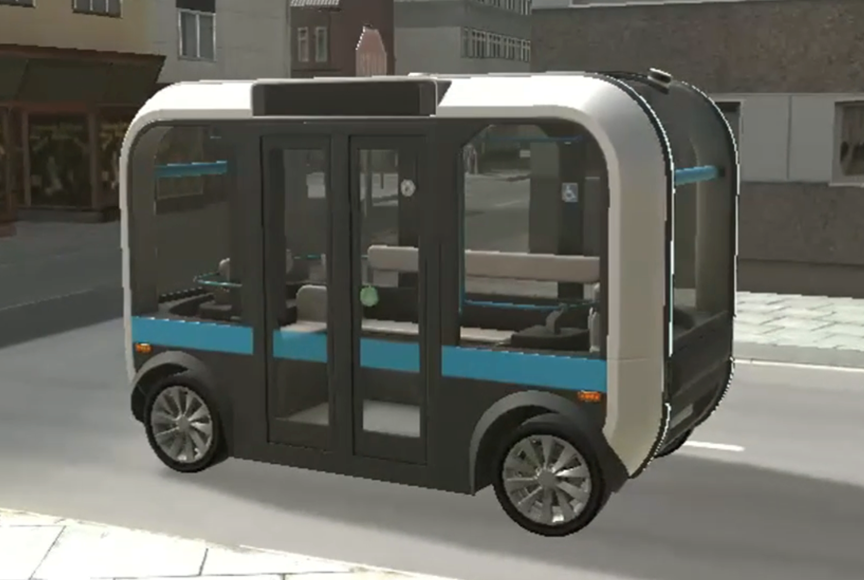
A first view on the digital twin: the shuttle interface demo
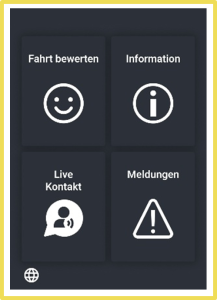
The workshop closed with a short demonstration of a passenger interface concept in a digital twinThe concept showed how passengers could contact the operator, receive updates, give feedback and report issues in a virtual autonomous shuttle. The discussion afterwards highlighted key design needs: clear wording, universal design, multilingual options, and privacy aware interaction, especially when several passengers share a small vehicle.


The workshop made one message very clear: fair and widely accepted automated mobility cannot be achieved by adding inclusivity as an afterthought. It needs early participation, clear responsibilities, and service design that fits real world constraints and the needs of different user groups.
What happens next in Karlsruhe
The final point directly informs Step 2 of the CulturalRoad co-creation framework: end-user focus groups using Virtual Reality (VR) and interactive visualisations. Building on stakeholder input, the next step will place a stronger emphasis on interfaces and vehicle-to-passenger communication as one feature of the sessions – exploring expectations, information needs and trust-building measures alongside other CCAM-related aspects.