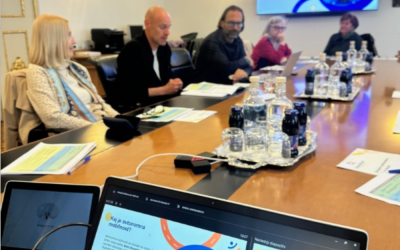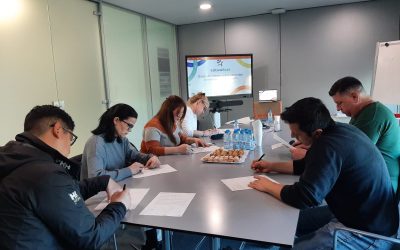
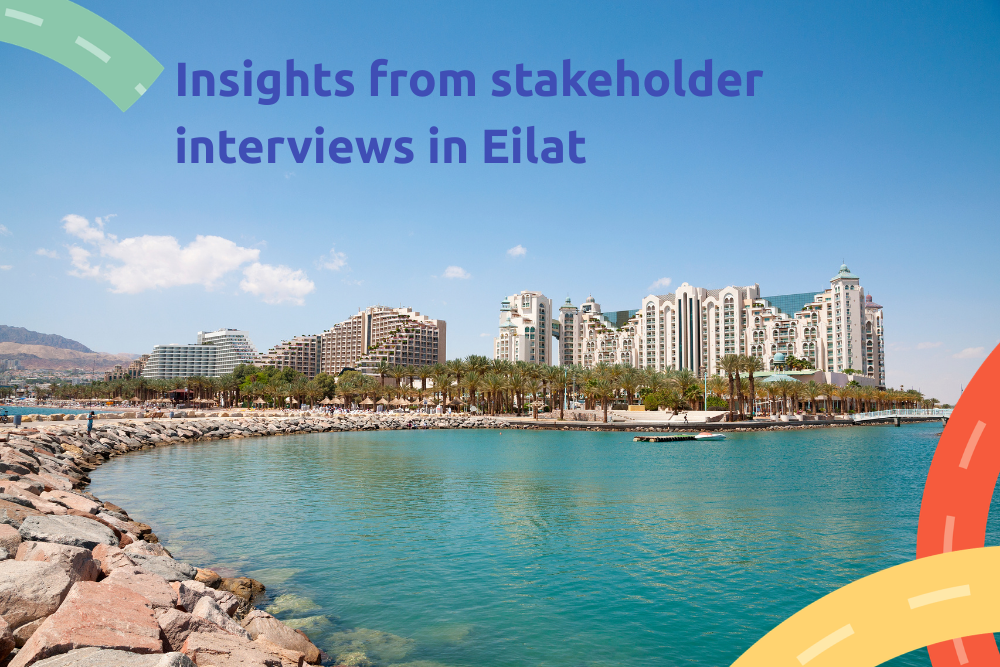
CulturalRoad employs a participatory co-creation framework to gather insights from transport planners and end users for the equitable deployment of CCAM services. Our demonstration site in Eilat completed the first phase of this co-creation framework in September and October 2025, when a series of eight structured, in-depth personal interviews were conducted with senior representatives from the Eilat Municipality, the Eilot Regional Council, the Ministry of Transport, the National Road Safety Authority, the marina management, and private transport service companies.
The interviews aimed to capture institutional visions, identify opportunities and challenges for the equitable integration of CCAM technologies, and assess the feasibility of local projects. These include the operation of an autonomous land shuttle from Ramon Airport to various destinations in the city, as well as the development of an innovative maritime shuttle connecting the northern and southern beaches along the sailing route, with particular emphasis on the needs of tourists, older adults, and people with disabilities.

Most interviewees demonstrated a high level of openness to technology adoption and innovation, alongside a clear willingness to promote and implement advanced technological solutions. Participants viewed automation as an opportunity to modernise public transport, reduce congestion and air pollution, and position Eilat as a technological pioneer. Furthermore, a perception emerged that innovation itself could serve as a tourist attraction and encourage a shift from private vehicles to autonomous public transport.
Safety emerged as a central advantage of the initiative and a necessary condition for its implementation. Although there was agreement that technology is perceived as having the potential to reduce accidents caused by human error, it was emphasised that its responsible implementation requires close supervision, gradual monitoring mechanisms, and addressing the shortage of safety professionals currently present in the industry. The clear recommendation was for gradual, controlled deployment accompanied by continuous oversight.
Shared concerns: regulation, ethics, and the need for clarification: Throughout the interviews, several cross-cutting issues emerged. Similarly to the other CulturalRoad demonstration sites, concerns were expressed regarding ethical and regulatory ambiguity, with some viewing the issue as more operational than moral. Most participants emphasised that in the absence of laws and a regulatory framework, technology implementation cannot be considered as meeting ethical standards.
Infrastructure readiness – a substantial disagreement: Significant differences of opinion were recorded among municipal and professional stakeholders: while some participants argued that the infrastructure required for implementation already exists on the ground, others noted that basic infrastructure is lacking and that the existing infrastructure is not properly organised to accommodate the technology. These differences highlight the critical need for a transparent and data-based methodological assessment to examine infrastructure needs in Eilat prior to making investment decisions.
Public acceptance – a condition for success: Representatives of the private and technological sector added that social acceptance depends entirely on adapting the technology to the real needs of the population. It was clarified that broad adoption of the service depends on precise adaptation to the needs of the local population and visitors to the city. Proposals were raised to integrate value-added services during the journey, such as the integration of content platforms, in order to improve the passenger experience and facilitate public adoption of the technology, alongside accessible design tailored especially to tourists, older adults, and people with disabilities.
Advancing the agenda: key priorities ahead
The series of interviews demonstrated that advancing CCAM in Eilat is not solely a technological question but a multi-system process requiring cooperation between local authorities, government ministries, and the private sector. Four main priorities emerged from the discussions:
- Infrastructure readiness assessment: advancing detailed planning for the pilot projects and examining the required maritime (docks) and land infrastructure (such as road signs and identification markings required for the implementation of autonomous transport).
- Safety and supervision: developing gradual and professional monitoring mechanisms to ensure the safety of road users.
- Promoting clear regulatory clarification: initiating dialogue with decision-makers to address the legal and ethical issues delaying deployment.
- Continuous focus on end users and ensuring public acceptance: further adapting the solutions specifically to the needs of Eilat’s diverse population, including tourists and the city’s various residents.
Eilat, as a relatively isolated tourism city with a clear spatial structure, offers a unique testing ground for examining an integrated model of autonomous land and maritime transport. The ongoing feasibility assessment process seeks to ensure that the implementation of the technology will be not only innovative, but also safe, equitable, and economically and environmentally viable.
Next step in the collaborative CulturalRoad process
Moving from the institutional vision to the voice of the end user. The completion of the interview series constitutes a critical milestone within the participatory framework of the project. The insights collected will serve as the basis for the second step, during which workshops will be held for two focus groups directly involving the city’s most mobility-challenged and vulnerable end user groups: older adults and tourists. This stage is intended to deepen understanding of their expectations and the social barriers they face. At the conclusion of the process, the results of the focus groups will be presented back to policymakers and stakeholders. This step is intended to ensure that users’ voices are translated into practical solutions and that the final assessment regarding the implementation of CCAM transport in Eilat will be transparent, inclusive, and effective.