The transition to a low-emission city is about much more than switching to electric cars and buses. It requires a fundamental change in the way we plan cities, their streets, and the mobility options available to residents and visitors.
Eilat faces a significant challenge: a growing tourism city where thousands of visitors move alongside residents, private vehicles, taxis, buses, trucks, and two-wheelers every day. In such an environment, continued reliance on polluting transport can increase congestion and exposure to air pollution.
Eilat’s multi-year plan for reducing transport-related air pollution proposes a broad transformation of the city’s mobility system, which includes the electrification of public transport and taxis, expanded public transport services, the promotion of walking and micromobility, the creation of low-emission areas, and the diversion of heavy truck traffic away from the urban environment.
But for this transformation to succeed, infrastructure and technology alone are not enough. We also need to understand what makes people choose one way of travelling over another. Is public transport accessible and convenient? Can it adapt its service to changing demand? Are cycling routes safe and continuous? Do pedestrians feel comfortable in public spaces? Are taxi drivers ready to switch to electric vehicles? And do residents and visitors feel that the new solutions actually meet their needs?
The public transport of the future
As part of this transformation, it is worth looking one step further ahead. The transition to electric buses is an important step towards cleaner transportation. The next step could be the gradual integration of connected and autonomous public transport – vehicles capable of operating automatically, communicating with infrastructure and other transport systems, and becoming part of a smart, multimodal mobility system.
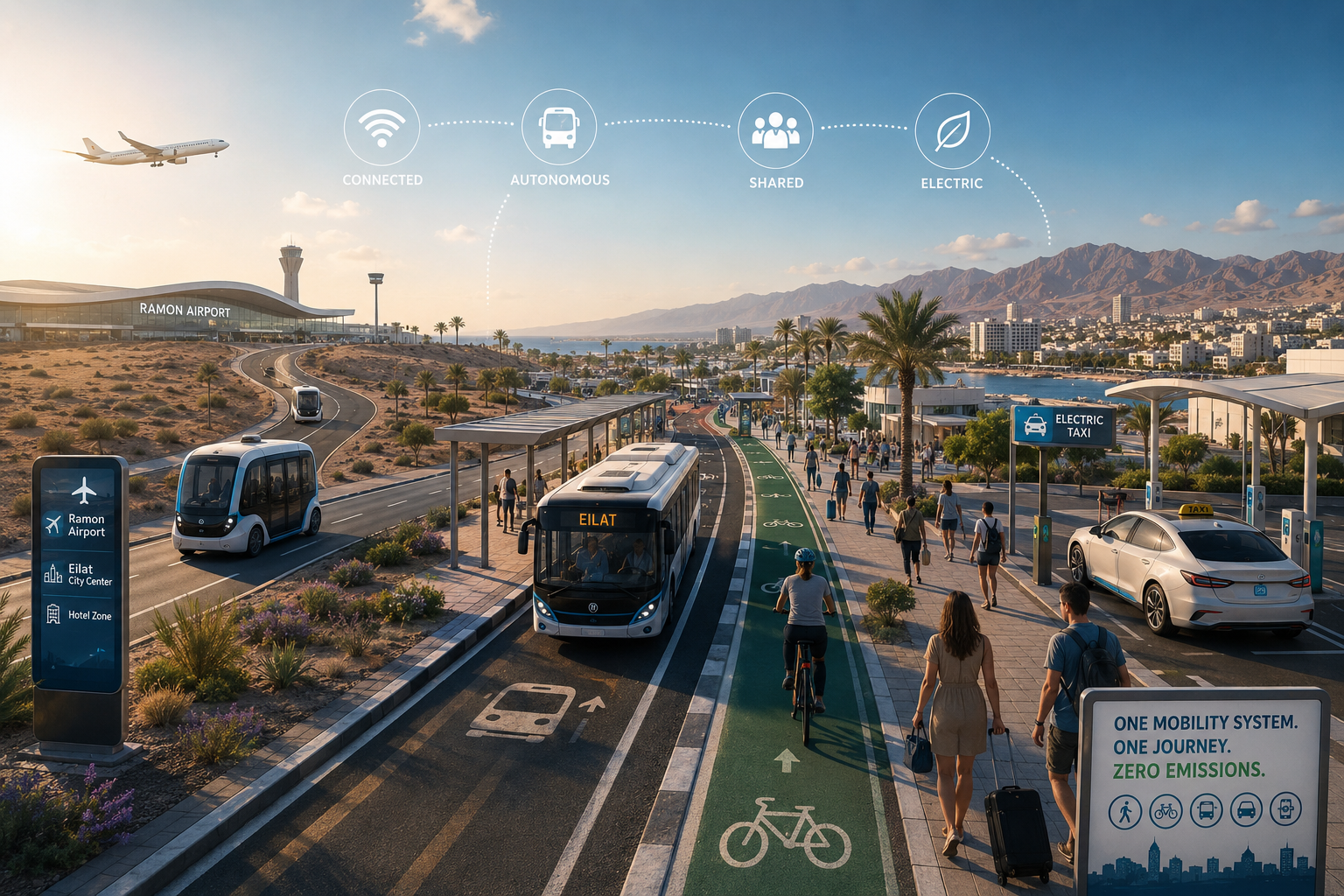
For a city like Eilat, these possibilities are particularly interesting. Connected and autonomous public transport could, in the future, help connect key destinations across the city, link new neighborhoods with employment centers, connect hotel areas with transport hubs, and address one of the region’s key mobility challenges: the connection between Ramon Airport and Eilat.
This connection represents an opportunity to rethink the concept of the “last mile”. Rather than viewing the journey from Ramon Airport to Eilat and the subsequent journey within the city as separate segments, we can envision one seamless mobility chain – from the moment a passenger lands at Ramon to the moment they reach their final destination in Eilat.
In the future, autonomous public transport could become part of such a system, providing an efficient and flexible connection between Ramon Airport and Eilat while complementing the city’s public transport and micromobility network.
Instead of thinking only about a fixed bus route operating along the same path at the same frequency, we can imagine a more flexible system capable of adapting services to demand, complementing the existing public transport network, and connecting different modes of mobility. But here too, technology is not the goal, and the real challenge is getting people to trust the system and use it. Passengers need to feel safe inside a driverless vehicle.
The system needs to be accessible to people who are not necessarily “tech-savvy”. Information needs to be clear and readily available, and the service needs to integrate naturally with buses, taxis, bicycles, and walking.
Therefore, when we talk about autonomous transport, we should not talk only about autonomy – but also about acceptance, accessibility, safety, and trust.
Technology that serves people
This is also one of the key challenges facing Eilat on its journey toward becoming a low-emission city.
The city’s multi-year plan recognises that transport transformation requires engagement with users and stakeholders. For example, in the field of electric taxis, this includes the development of a fast-charging network and involving stakeholders in determining the locations of charging stations, while addressing drivers’ concerns, including range anxiety.
The promotion of micromobility is also about more than simply adding bicycle lanes. The goal is to create a continuous and safe network that can shift short trips away from private cars and toward active modes of transport.
The same principle should guide autonomous transport. It is not enough for technology to work; it needs to work for people – a key principle at the heart of CulturalRoad’s work. This means planning a system in which residents, passengers, drivers, transport operators, businesses, and local authorities all have a role in shaping the system. The questions we need to ask are not only “What technology can do?” but also “What do users need?”, “What are they concerned about?”, and “What conditions will encourage them to adopt the solution?”
Along the Ramon-Eilat corridor in particular, one of CulturalRoad’s demonstration sites, these questions take on special importance: Who are the users? How do the needs of tourists differ from those of residents? How can the system serve passengers with disabilities or reduced mobility? How do we create a sense of safety and trust in an autonomous vehicle? And how do we ensure that the service complements the existing transport system rather than operating alongside it as a separate solution? These are not merely technological challenges but questions of planning, usability, accessibility, and trust.
From electric buses to a smart mobility system
Eilat’s transition to a low-emission city can therefore be much more than replacing diesel engines with electric ones. It can be an opportunity to rethink the way people move across the city and the wider region. Electric buses can provide the foundation, while autonomous public transport could be the next step.
The connection between Ramon Airport and Eilat could become one of the corridors where this technology is tested and integrated into the wider mobility system. Micromobility and walking can complete shorter journeys, digital systems can connect all these options, and urban and regional planning can ensure that they operate as one integrated system.
Eilat’s multi-year plan estimates that full implementation of the proposed measures could reduce annual emissions by approximately 54.96 tonnes of NOx, 3.49 tonnes of PM2.5, and 2,740 tonnes of CO₂. These are significant numbers, but behind the numbers lies a larger goal: to create a cleaner, more accessible, safer, and more attractive transport system in Eilat – one that people actually want to use.
The city of the future will not simply be a city with fewer emissions. It will be a city where technology, infrastructure, and people work together to create a better way to move – from Ramon to Eilat, and throughout the city itself. And the journey starts with people.
Image has been generated by AI.